Formats and Editions
1. Noche De Lluvia (Feat. Verna Wiebe)
2. Sensemayá (Feat. Tony Cyre & Verna Wiebe)
3. Olvido (Feat. Verna Wiebe)
4. Ta Tikee Tei (Feat. Tony Cyre)
5. Prayer At Night (Feat. Sharon Atkinson & Verna Wiebe)
6. Morena
7. Ir Me Quero La MI Madre
8. Cuando El Rey Nimrod
9. I Call Forth The Song (Feat. Verna Wiebe)
10. Souls, Where Have You Gone? (Feat. Verna Wiebe)
11. Canzoni Romane (Feat. Tony Cyre, Members Of The Manitoba Chamber Orchestra & P.J. Buchan)
12. Hymn Of Confidence (Feat. Tony Cyre & Verna Wiebe)
13. Hymn Of Longing (Feat. Tony Cyre & Verna Wiebe)
14. Hymn Of Glory (Feat. Tony Cyre, Pembina Trails Boys Choir & Verna Wiebe)
More Info:
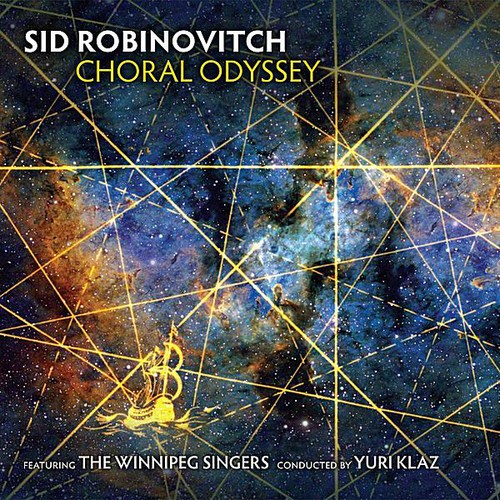
Sid Robinovitch - Choral Odyssey Performed by the Winnipeg Singers under the direction of Yuri Klaz 'Choral music has always been at the core of my work as a composer. This was the first music that I wrote, and it is to this form of expression that I always return. I have written many different kinds of choral music over the years - original pieces on secular themes, settings of religious texts, children's songs, and arrangements of folk material. This CD takes us on journeys through different times and places, from the ancient Near East through the lands of the Mediterranean to Latin America and the Canadian Arctic. But whatever the style of the music and whatever it's geographical or historical point of reference, it is the sound of human voices singing in combination with each other which never fails to excite and inspire.' Sid Robinovitch A native of Manitoba, Sid Robinovitch received his doctorate in Communications from the University of Illinois and taught social sciences at York University in Toronto. Since 1977 he has devoted himself to musical composition having studied at Indiana University and at the Royal Conservatory of Toronto. He presently lives in Winnipeg, Canada, where he works as a composer and teacher. Robinovitch's music has been widely performed in Canada and abroad, having been featured by groups such as the Elmer Iseler Singers, the Vancouver Chamber Choir, the Canadian Piano Trio, and the Winnipeg, Toronto, and Louisville Symphony Orchestras. His works have been frequently broadcast on CBC radio, and he has also written music for film and TV where he is best known for his theme for the satirical comedy series, The Newsroom. While many of Robinovitch's works are rooted in traditional or folk material, they often have a distinctly contemporary flavor as well. Dreaming Lolita, for example, is a dramatic retelling in poetic form of the famous Nabokov novel, and in Psalms of Experience the choral textures are infused with elements of Balinese music and rhythmic chanting. Klezmer Suite, a recording devoted entirely to his music performed by the Winnipeg Symphony under the direction of Bramwell Tovey, was nominated for a 2002 Juno award and received a Prairie Music Award for outstanding classical recording. Sefarad, a CD featuring his music for guitar, was released in 2008 on the Marquis label and received both Juno and Western Canadian Award nominations for classical recording of the year. Contents of album: I. Canciones Por Las Américas 1. Noche de Lluvia (Rainy Night) (Track 1 - 4:56) 2. Sensemayá (Chant for killing a snake) (Track 2 - 3:59) 3. Olvido (Oblivion) (Track 3 - 8:23) The three movements of Canciones Por Las Américas reflect different currents within the Latin American experience. The first movement is a love song and has a traditional Spanish flavor. The second echoes the African heritage of the text's Cuban author, while the third is of a more reflective nature, revealing the inward psychological orientation of the modern world. II. Ta Tikee Tei (Track 4 - 3:34) A movement from a work entitled 'Soundchants' where the words consist of made-up sounds from no particular language. The style of this one seems to have affinities with East Indian music. III. Prayer At Night (Track 5 - 8:29) This piece was commissioned by the Winnipeg Singers and premiered by them in February, 2000. The text, sung in Hebrew, is taken from the Book of Psalms. The mood is quiet and contemplative, the words being reflective of the kind of soul-searching that often rises to the surface during the course of the night. The chorus begins with an a cappella section, and then continues with a steady pulse provided by the piano accompaniment. The music is then repeated, but this time with clarinet obligato. Except for a brief return to the opening a cappella material, the clarinet continues to embroider upon the choral harmonies to the end of the piece. IV. Three Ladino Folk Songs 1. Morena ('The Brunette') (Track 6 - 2:13) 2. Ir Me Quero La Mi Madre (I Must Go Wandering, O my mother) (Track 7 - 3:36) 3. Cuando El Rey Nimrod (When King Nimrod Rode Out) (Track 8 - 1:58) Ladino is the language spoken by the Jewish people that dispersed throughout the various countries of Europe and the Mediterranean after being expelled from Spain in 1492. Although primarily Spanish in character, Ladino incorporates many words from other languages such as Turkish, Greek, Hebrew, French and Italian. The three songs that make up this set are but a few of the hundreds of Ladino folk songs that have come down to us. The first song tells of a woman ('The Brunette') who has lost her youthful allure and is now somewhat of a subject of mockery. The second song depicts a person who must go off to drown his sorrows in solitude. The final song is a tale about the birth of the patriarch, Abraham, and is no doubt inspired by Christian models. V. Two Inuit Songs 1. I Call Forth the Song (Track 9 - 4:26) 2. Souls, Were Have You Gone? (Track 10 - 3:05) The words for these songs are English translations of Inuit folk poetry collected in the Canadian arctic. The first piece is a meditation on Inuit life with references to caribou, the paltry fish catch, and the Northern dawn. The second song is an invocation of ancestral spirits. VI. Canzoni Romane (Roman Songs) (Track 11 - 17:41) The text for this work is taken from poetry by Pier Paolo Pasolini, one of the leading figures in the Italian neo-realist movement of the post-war period. Born in Bologna in 1922, Pasolini lived in Rome until his death in 1975. As a Catholic and a Communist, his ideal of popular art led to his work in the cinema where he became one of the best known screenwriters and directors of his generation. His style in poetry and film was stark, but compassionate, emotional, but never sentimental. Pasolini's murder, at the age of fifty-three, was a tragedy for Italy's artistic community. The piece, sung in the original Italian, is in three sections, depicting different scenes from Roman life. It begins with a promenade along the sea, following the movements of boys with "blue jeans the color or carrion, and white, clinging, filthy sweaters." The boys go into a poor open-air shop, buy some food, and then eat outside in silence. After a brief meditation by the tenor soloist on the anguish of living a spent love, the scene shifts to Rome itself "in the enchanted heat of the night." Market piazzas, empty inns, and the smell of straw give rise to musings on the lessons taught by this "stupendous and poor city." Another solo interlude dealing with the poet's feelings of isolation leads to the third section which is set in the sprawl on the outskirts of the city with "tough and scrawny kids screeching in their ragged undershirts." The piece ends with the tenor soloist expressing the poet's bitter-sweet sense of awe for this rough-and-tumble world. VII. Psalms of Experience 1. Hymn of Confidence (Track 12 - 4:11) 2. Hymn of Longing (Track 13 - 6:19) 3. Hymn of Glory (Track 14 - 5:30) The title Psalms of Experience is intended to remind us that the Psalms of the Bible, although speaking specifically of one's relationship with God, reflect life experiences with which we are all familiar - the confidence of youth, the doubts and longings of mid-life, and the sense of peace and glimpses of eternity that come with the latter years. The music in this work is of a direct and elemental nature, incorporating Middle-Eastern and Oriental influences, as well as elements from the Western tradition. The second movement is recited dramatically and the third movement features a repeated motive in the piano which is reminiscent of the Balinese gamelan. The text is sung in the original Hebrew.